
Quick answer: A water softener removes hardness minerals (calcium and magnesium) that cause scale. A water filter removes things like chlorine taste and odor, chemicals, sediment, iron or sulfur, depending on the type. On city water, most Central Florida homes benefit from a whole-house carbon filter plus a softener. On a private well, you usually need more: a sediment filter, an iron/sulfur filter, a softener and UV disinfection. BSP1 Plumbing (CFC1432849) installs both in St. Cloud and Orlando. See our well water treatment service.
Softener vs. filter: they solve different problems
People often use the two words as if they mean the same thing. They don’t.
- A water softener uses ion exchange to swap hardness minerals for sodium (or potassium). It stops scale, but it does not make water taste better and does not remove chlorine, bacteria or most chemicals.
- A water filter traps or reacts with specific contaminants. A carbon filter targets chlorine, chloramine and many organic chemicals. A sediment filter catches sand. An iron/sulfur filter targets iron, manganese and the rotten-egg smell. None of them soften water.
City water vs. well water in Central Florida
City water
Your utility treats and disinfects the water before it reaches you, and it must meet federal drinking water standards. The common complaints are hardness (Central Florida’s groundwater comes from a limestone aquifer) and the taste or smell of the chlorine or chloramine used for disinfection.
Typical setup: whole-house carbon filter + water softener. Optional reverse osmosis (RO) at the kitchen sink for drinking water.
Well water
A private well is not treated by anyone but you. Florida wells commonly have hardness, iron (orange stains), hydrogen sulfide (rotten-egg smell), sediment, low pH in some areas, and sometimes bacteria. Health officials recommend testing private wells at least once a year.
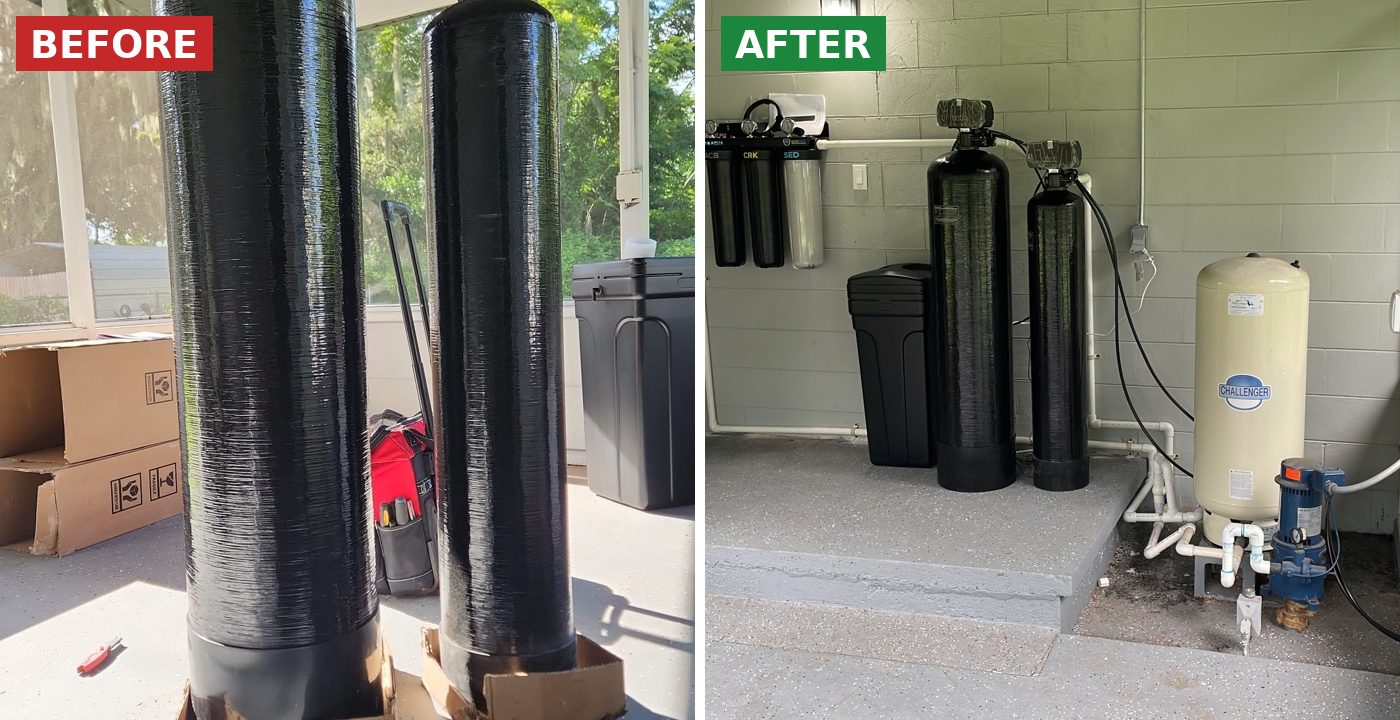
Typical setup: sediment filter → iron/sulfur filter → water softener → UV disinfection, plus RO for drinking water. The order matters: UV only works on clear water, and high iron ruins softener resin.
Pros and cons
Water softener
- Pros: no scale on faucets and glass, longer water heater and appliance life, better lather, softer-feeling skin and hair.
- Cons: salt refills, adds a little sodium, uses water to regenerate, and does not fix taste, odor or bacteria.
Whole-house carbon filter
- Pros: better taste and smell at every tap, removes many chemicals, low maintenance, no salt.
- Cons: does not soften; the media must be replaced on schedule.
Iron / sulfur filter (wells)
- Pros: ends staining and the rotten-egg smell.
- Cons: needs backwashing and periodic media service; must be sized to the well pump.
UV disinfection (wells)
- Pros: treats bacteria without adding chemicals.
- Cons: needs pre-filtered water and a yearly lamp change.
Salt-free “conditioners”
- Pros: no salt, no drain line, low maintenance.
- Cons: they reduce how scale sticks to surfaces but do not actually remove hardness, so results are more limited than a true softener.
How to choose the right system
- Test the water first. Hardness, iron, smell, pH and sediment, plus a certified lab test for bacteria on a well.
- Match the equipment to the problem. Do not buy a softener to fix a smell or a filter to fix scale.
- Size it to your home. The number of bathrooms and the well pump flow decide the tank sizes.
- Plan for maintenance. Salt, cartridges, media and UV lamps all have schedules.
- Use a licensed plumber. Proper bypass valves, drain lines and backflow protection keep the system serviceable and up to code.
Moving from a well to city water?
If your area is getting city water, you may not need the well equipment anymore, but a softener and carbon filter are still worth considering. See our guide to septic-to-sewer and well-to-city-water conversions.
Why homeowners in St. Cloud and Orlando call BSP1 Plumbing
We install softeners, whole-house filters and complete well water systems, sized for your home, with same-day service, financing through Wisetack and a written warranty. Licensed CFC1432849. Call (321) 732-5615 or schedule online. ★★★★★ Hundreds of 5-star reviews on Google.
Frequently asked questions
Do I need a water softener or a water filter?
It depends on the problem. Scale and spots mean a softener; chlorine taste and smell mean a carbon filter. Many city water homes use both, and well water usually also needs iron/sulfur filtration and UV.
Does a water softener remove chlorine?
No. A softener only removes hardness minerals. You need a carbon filter for chlorine and chloramine.
Why does my well water smell like rotten eggs?
Usually hydrogen sulfide gas in the groundwater. A sulfur or iron filter, often with air injection, removes it. If the smell is only in hot water, the water heater anode rod may be involved.
Is softened water safe to drink?
Softening adds a small amount of sodium. Most people drink it without issue; people on low-sodium diets can use a reverse-osmosis unit at the kitchen sink.
How often should a private well be tested?
At least once a year for bacteria, and again after flooding, well repairs or any change in taste, smell or color.