Call three Orlando plumbers about a collapsed sewer line and you will get three very different recommendations. One will push trenchless. One will say you need a full dig-up. One will try to sell you a camera inspection at a steep rate and then not follow through.
Here is the honest explanation of what trenchless is, when it actually makes sense, and when a traditional repair is the smarter call — from a Central Florida plumber who doesn’t upsell trenchless.
What “trenchless” actually means
Two common techniques get called trenchless:
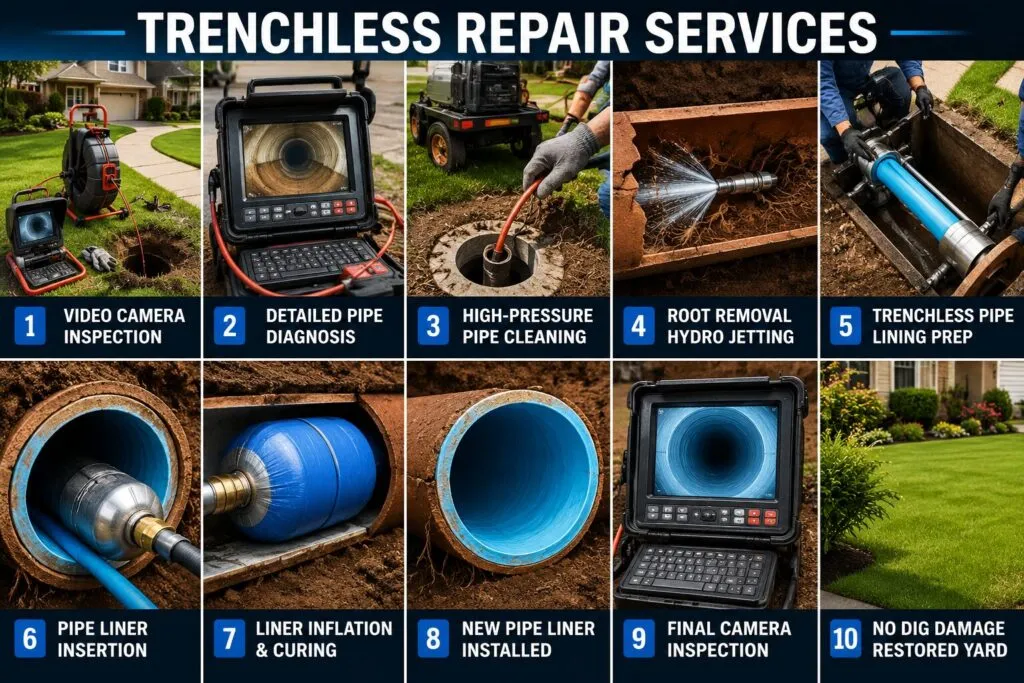
- Pipe lining (CIPP): a resin-soaked flexible liner is inserted into your existing pipe, inflated, and cured in place with heat or UV. The old pipe becomes the mold; the liner becomes the new pipe. One access pit at each end is all that is needed.
- Pipe bursting: a cone-shaped head is pulled through the old pipe, breaking it outward while dragging a new HDPE pipe behind it. Two access pits.
Both avoid a 50-foot trench across your lawn, driveway or sidewalk. Neither one is magic. They have specific conditions where they work — and specific conditions where they are the wrong call.
When trenchless is the right choice
1. The pipe runs under something expensive to dig up
Under a paver driveway, a mature oak, a concrete pool deck, or your front landscaping — this is where trenchless pays for itself. A long dig-up under a paver driveway can cost thousands in restoration alone. Trenchless skips that.
2. The pipe is still structurally mostly there
Lining needs a tube of pipe to line. If the pipe has collapsed at a section, lining will not bridge the gap — the resin will blow out. For partial collapses a combo approach is often right: dig-up at the collapsed section, line the rest.
3. Long runs with heavy root intrusion
Older Orlando neighborhoods (Winter Park, Audubon Park, Colonialtown) have cast-iron sewers from the 1950s-70s running past big grandfather oaks. The roots keep coming back no matter how often you jet. CIPP lining gives you a smooth interior wall with no joints for roots to enter.
4. You’re in an HOA or city right-of-way
Permits and restoration fees in HOAs or along city sidewalks can double a dig-up bid. Trenchless with just two small pits often avoids most of those fees.
When trenchless is the wrong call (and lots of homeowners get sold on it anyway)
1. The line is fully collapsed in multiple sections
Nothing to line. Open trench replacement is the right call.
2. Sagging (belly) in the pipe
Lining a belly makes it a permanent belly. You will clog there forever. The right fix for a sewer belly is to dig it up and re-set the pipe to grade. We see this on 1970s Kissimmee homes where the fill under the slab settled and the sewer sagged with it.
3. Short runs
Under 20 feet, the setup and equipment time for lining or bursting erases the trench-savings. Dig it up, replace it, move on.
4. The pipe material is wrong
Terracotta (common in mid-century Orlando homes) is fragile and does not always take lining well. Orangeburg (tar-paper pipe used 1945-1972) has to be dug up; you cannot line it.
What BSP1 recommends and does
We will tell you honestly whether trenchless is the right fit for your specific line. When it is, we refer you to a specialist contractor we trust — we don’t do trenchless ourselves and we don’t want to be the ones who get it wrong on your property.
Where BSP1 is the right call is everything else that makes up the 80% of sewer jobs in Central Florida:
- Main sewer line clearing with video camera inspection: starting from $425 (camera included). This is the first and only honest starting point for diagnosing a sewer issue.
- Main sewer line clearing without camera: starting from $250 (when you already know the problem).
- Standalone sewer camera inspection: starting from $290.
- Hydro jetting: starting from $650 (camera inspection included). For heavy grease, root mats and recurring backups where regular snaking keeps coming back.
- Traditional open-trench sewer line repair and replacement (quoted flat-rate after camera inspection).
- New sewer line installation (quoted flat-rate).
Start with a camera inspection, not a guess
Sewer problems look very different on the inside than you would guess from the outside symptoms. Backup at one toilet might mean a clog three feet in, or a full collapse 40 feet out. Our camera inspection is recorded so you can see exactly what shape the pipe is in before anyone quotes a repair.
What to ask any contractor before you sign
- Can I see the camera footage of the problem?
- If trenchless was recommended, why is it the right fit for THIS specific line (not just a general sales pitch)?
- Is the restoration (concrete, pavers, sod) included or separate?
- What is the warranty on the pipe itself vs the restoration?
- Will you pull the permit?
If a contractor will not show you the camera footage or will only quote trenchless without discussing the alternative, walk away.
Ready to start?
Call us at (321) 732-5615 or book online. We will run a recorded camera inspection, show you exactly what is wrong, and give you an honest assessment — including when trenchless is the right call and who to call for it.
Related reading: Sewer Line Repair · Camera Inspection · Hydro Jetting · Sewer Line Installation