
Quick answer: A slab leak is a water leak in the pipes beneath your home’s concrete foundation. The most common signs are a sudden jump in your water bill, warm or damp spots on the floor, low water pressure, the sound of running water when everything is off, and new cracks in floors or walls. In Central Florida — where most homes sit on concrete slabs — catching a slab leak early can save you thousands in water and foundation damage.
What is a slab leak?
Your home’s water and drain lines often run through or under the concrete slab it sits on. When one of those pipes cracks, corrodes, or wears through, water escapes under the foundation. That is a slab leak — and because it is hidden, it can go unnoticed until the damage is serious.
7 warning signs of a slab leak
- A spike in your water bill with no change in usage
- Warm spots on the floor (if it is a hot-water line)
- Damp, wet, or discolored areas on the floor or carpet
- Low water pressure throughout the house
- The sound of running water when all fixtures are off
- Cracks in the floor, walls, or baseboards
- A musty smell or mold from moisture under the slab
What causes slab leaks in Florida homes?
Common causes include corrosion of copper or galvanized pipes, poor initial installation, shifting soil, high water pressure, and Florida’s hard water wearing pipes from the inside. Older homes and those with copper lines are especially prone.
What should you do if you suspect a slab leak?
- Do not ignore it. A small slab leak only gets worse — and more expensive.
- Check your water meter: turn off all water, then watch the meter. If it keeps moving, you likely have a hidden leak.
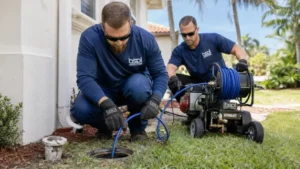
- Call a licensed plumber for leak detection. Pros use electronic and acoustic equipment to pinpoint the leak without tearing up your whole floor.
How a slab leak is confirmed and located
Guessing is expensive, so the process starts with proof. First we isolate the system: with every fixture off, the water meter should not move; if it does, water is leaving the pipes somewhere. A pressure test on the hot and cold lines then tells us which side is losing pressure, which usually points to a hot-water leak, the most common kind under Florida slabs because the heat makes the copper or CPVC work harder. From there, electronic listening equipment picks up the sound of water escaping under pressure, and a thermal camera shows the warm plume spreading through the concrete. The result is a mark on the floor within a few inches of the leak, which is the difference between opening one small section of slab and tearing up a room.
Repair options: spot repair, reroute, or repipe
- Spot repair. The slab is opened at the marked location, the failed section is replaced, and the floor is restored. Best when the pipe is otherwise in good shape and the leak is in an accessible area.
- Reroute. The leaking line is abandoned in the slab and a new line is run overhead through the attic or walls. Often faster and less disruptive than breaking concrete, and it removes that run from future slab risk.
- Whole-home repipe. When a home has had more than one slab leak, or the original piping is aging polybutylene, galvanized, or thin-wall copper, replacing the supply system with PEX ends the cycle instead of chasing the next leak.
We walk you through which option makes sense for your home’s age, piping material, and the location of the leak, with a firm price for each.
Why Central Florida homes get slab leaks
Most houses in Orlando, Kissimmee, and St. Cloud sit on a monolithic concrete slab with supply lines running underneath. Over the decades, three things wear on those lines: slightly acidic or mineral-heavy water that corrodes copper from the inside, ground movement and settling that stresses joints, and abrasion where a pipe rubs against rebar or gravel as it expands and contracts with hot water. Homes built from the 1970s through the 1990s are the most frequent callers, but any slab home with original piping can develop one. Catching it early protects the slab itself; prolonged leaks wash out soil, and that is when foundation problems begin.
How BSP1 Plumbing finds and fixes slab leaks
We use professional electronic leak detection to locate the exact spot — no guesswork, no unnecessary demolition. Then we walk you through the repair options with an upfront price before any work begins. We serve Orlando, Kissimmee, St. Cloud, and the greater Orlando metro, and we are licensed (CFC1432849), insured, and bilingual.
Think you have a slab leak? Call (321) 732-5615. ★★★★★ Hundreds of 5-star reviews on Google. for same-day detection across Central Florida.
Frequently asked questions
How much does slab-leak detection cost?
In the Orlando area, professional leak detection typically starts around $300. We give you a firm price before we begin, and detection lets us fix only what is needed instead of guessing.
Can a slab leak get worse if I wait?
Yes. A slow slab leak can undermine your foundation, cause mold, and ruin flooring. Early detection is always cheaper than emergency repair.
Do I have to break up my whole floor to fix it?
Not usually. With accurate detection we can often do a targeted spot repair or reroute the line, avoiding major demolition.
Do you serve my area?
We cover Orlando, Kissimmee, St. Cloud, Lake Nona, Winter Park, Oviedo, Windermere, Lake Mary, Winter Garden, and surrounding Central Florida communities.