
If your kitchen sink is more than ten years old and it keeps clogging no matter how many times it gets snaked, you are not dealing with a clog. You are dealing with a pipe that is slowly closing up from the inside. We see it every week in Orlando, Kissimmee, and St. Cloud kitchens, and the pattern is always the same: a plumber snakes the line, it drains for a few weeks, and then it backs up again. Here is why that happens, and why hydro-jetting is the only method that actually fixes it.

The real problem: years of grease build-up
Every time you rinse a pan, run the dishwasher, or pour a little cooking oil down the sink, a thin film of grease coats the inside of the drain line. Hot water carries it a few feet, then it cools and sticks to the pipe wall. Day after day, year after year, those films harden into a thick, waxy layer that narrows the pipe. In a ten-year-old kitchen line, it is common to find a 2-inch pipe with a half-inch opening left in the middle. Food particles, coffee grounds, and soap scum catch on that rough surface and the drain slows to a crawl. Central Florida’s hard water makes it worse, because mineral scale bonds with the grease and makes the layer even harder.
Why snaking only buys you a few weeks
A drain snake is a cable with a cutting head. It is excellent at boring through a single obstruction. But in a grease-lined kitchen pipe, there is no single obstruction; the whole pipe is the obstruction. The snake punches a hole through the center of the grease and water starts flowing again, which feels like a fix. The grease layer, however, is still there, coating the pipe wall from the sink to the main. Within weeks the new hole fills back in, usually faster than before because the surface is rougher. You are back where you started, minus the cost of the service call. Read more in our guide to drain snake vs. hydro-jetting.
Why hydro-jetting is the real solution
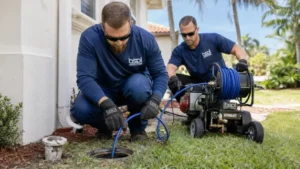
Hydro-jetting does not bore a hole; it cleans the pipe. A specialized nozzle sprays high-pressure water backward and sideways as it travels through the line, shearing the hardened grease off the pipe wall and flushing it out to the main sewer. When it is finished, the pipe is back to very near its original diameter, with a smooth interior that resists new build-up. That is why a properly jetted kitchen line does not just drain today; it keeps draining. In our experience a thorough jetting of an older kitchen line routinely holds for 10 years or more with normal use.
Then a camera, to prove it is clean
After jetting, we run a sewer camera through the line. You see the pipe wall on the monitor, clean from end to end. This does two things: it proves the job is done rather than asking you to take our word for it, and it confirms the pipe itself is sound, with no cracks or bellies that would cause future problems. If the camera shows a damaged section, you find out now, with a clear picture, instead of after the next backup.
What it costs, and why it saves you money
Let us be direct about the numbers. A standard kitchen drain snaking starts around $225. Hydro-jetting the same line starts around $680. On a single visit, snaking is cheaper, and if your line is new and the clog is a one-time event, snaking is the right call.
For an older, grease-lined kitchen drain, the math flips. If snaking has to be repeated every few months, three or four visits cost more than one jetting, and you still have a dirty pipe at the end of it. One hydro-jetting, confirmed by camera, gives you a clean line that holds for years. It is the lower total cost, the fewer headaches, and the only one of the two that actually addresses the cause. We give you upfront pricing on both so you can decide with the real figures in front of you.
How to keep the line clean after jetting
- Collect grease in a can and throw it away; never pour it down the sink.
- Scrape plates into the trash before rinsing.
- Keep coffee grounds and fibrous scraps out of the disposal.
- Run hot water for 30 seconds after washing greasy cookware.
- Use a strainer in the sink basket.
These habits are the difference between a jetting that lasts a decade and one that lasts a few years.
Frequently asked questions
Why does my kitchen sink keep clogging after being snaked?
Because the snake only punched a hole through a layer of hardened grease that still coats the whole pipe. The hole fills back in within weeks. Hydro-jetting removes the grease layer itself, which is why it lasts.
How much does it cost to hydro-jet a kitchen drain?
Hydro-jetting a kitchen line starts around $680, versus around $225 for snaking. For an older grease-lined drain, one jetting typically replaces several repeat snakings and holds for years.
Is hydro-jetting safe for old kitchen pipes?
Yes, for pipe that is structurally sound, which is why we check with a camera. Jetting is safe for PVC and healthy cast iron; it is not used on pipe that is already cracked or collapsing.
How long does hydro-jetting a kitchen drain take?
Usually one to two hours, including the camera inspection afterward.
Fix your kitchen drain for good
Blessed Solutions Plumbing provides hydro-jetting, camera inspections, and complete drain cleaning throughout Orlando, Kissimmee, St. Cloud, and Central Florida, with upfront pricing and hundreds of 5-star reviews from homeowners who were tired of snaking the same sink. Stop paying to clear the same drain.
Call (321) 732-5615 or schedule online to book kitchen drain hydro-jetting today.